


What Drives Aluminum Coil Price Changes in Industrial Supply Contracts
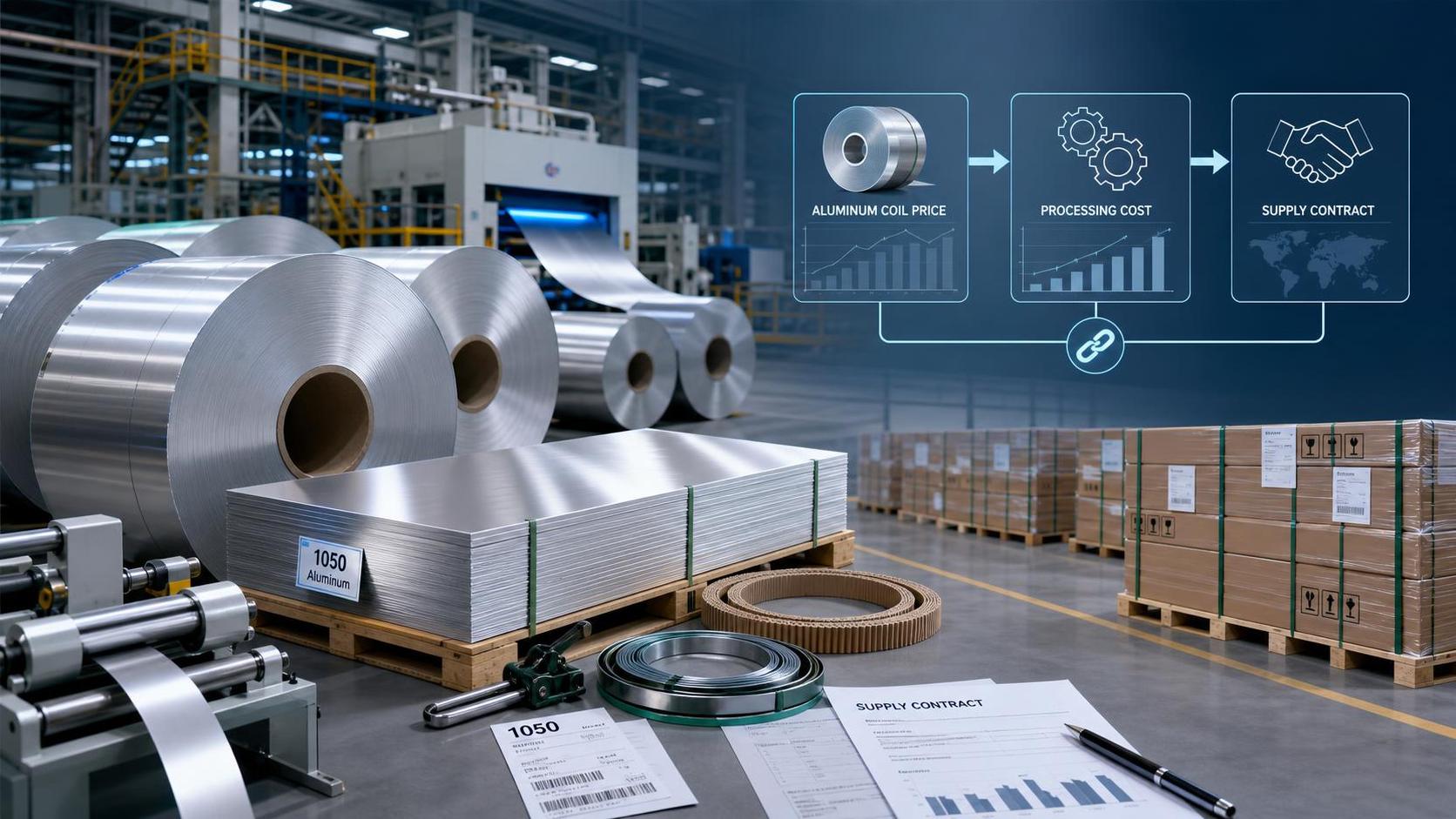
What Finance Teams Are Really Approving When They Review Aluminum Coil Prices
The biggest mistake in an industrial buying review is treating aluminum coil price as if it were a single market number. It is not. What appears on a supplier quotation is usually a stack of cost layers: base metal value, conversion cost, surface treatment, width and thickness yield, packaging, freight exposure, payment terms, and sometimes contract timing risk. If a finance approver looks only at the final figure per ton, two quotes can seem comparable while carrying very different commercial assumptions.
That matters because aluminum coil procurement rarely behaves like spot buying of a standard commodity. In real supply contracts, the quoted price often reflects both metal volatility and manufacturing specificity. A plain mill-finish coil and a color-coated or tightly toleranced coil do not respond to market pressure in the same way. The metal component may rise or fall with exchange-traded aluminum prices, but the processing component can move for completely different reasons, including energy costs, line utilization, coating materials, labor pressure, and order complexity.
The Metal Price Is Only the Starting Point
When procurement teams ask why the aluminum coil price changed this month, the first reference point is usually the underlying aluminum market. Suppliers commonly build quotations around a metal benchmark plus a fabrication premium. The benchmark can move quickly. That part is visible. What is less visible is that the premium does not always move in parallel. In a weak metal market, conversion charges can remain firm if rolling capacity is tight or if downstream demand is stable in construction, transport, electrical equipment, or packaging.
This is where finance review needs discipline. A lower benchmark does not automatically mean the total purchase should be lower. If the order requires narrow gauge tolerance, special temper, additional slitting, protective film, export packaging, or smaller batch production, the processing share of the quote becomes more important. In some cases, the commercial gap between two suppliers says more about production configuration than about metal sourcing efficiency.
Energy, Yield Loss, and Specification Complexity
Aluminum rolling is energy-sensitive. Smelting is even more so, but rolling and finishing costs also respond to electricity and fuel conditions. Buyers often underestimate this in contract discussions. If energy prices rise, suppliers may not revise every quote immediately, yet over a contract cycle the pressure usually appears in processing fees, especially for products requiring repeated passes, heat management, coating, or strict surface quality control.
Yield loss is another hidden driver. A contract for standard dimensions is easier to price than one built around custom widths, unusual thicknesses, or demanding flatness expectations. The more the production line must adjust around a customer-specific requirement, the more scrap risk and downtime the supplier carries. That is why two coils made from similar alloy families can land at different prices even before freight is considered.
For example, if the application calls for high conductivity and clean surface performance, a grade such as 1050 may be selected because of its aluminum content of at least 99.5%, along with strong corrosion resistance and good formability. In practice, that decision affects not only technical suitability but also contract structure, because purity, temper, and finish requirements shape processing cost. Products such as Aluminum sheets 1050 Series are often evaluated less by headline price alone and more by whether the specification actually matches the use case without overbuying performance.
Volume Helps, but Only When the Order Is Operationally Efficient
Large volume usually improves price, but not in a simple linear way. Finance teams sometimes assume that any annual contract should generate a strong discount. Suppliers look at volume differently. They care about release predictability, product mix stability, production scheduling, and whether tonnage can be run in efficient campaigns. A high annual number split into irregular small releases across many specifications may be less attractive than a smaller but more stable order book.
This is one reason long-term contracts can disappoint internal expectations. The buyer commits volume, but the supplier still sees fragmented manufacturing demand. In that situation, the aluminum coil price may not improve much because the operational burden remains high. The useful question for finance is not only “How much are we buying?” but also “How buyable is this demand from the mill’s point of view?”
Global Supply Conditions Change the Quote Even When Local Demand Looks Calm
Industrial aluminum pricing is exposed to more than plant-level economics. Freight rates, port congestion, trade restrictions, regional capacity shifts, and currency movement can all change delivered cost. A supplier exporting to multiple countries has to manage these variables continuously. For a company with broad production coverage and overseas shipments across more than 30 countries, contract pricing often reflects not just mill cost but also export packing standards, logistics planning, and the risk of timing mismatches between order confirmation and shipment.
That does not mean every supplier surcharge is justified. It means finance approvers should ask where the exposure sits. Is the quote ex-works, FOB, or delivered? Is ocean freight locked, estimated, or passed through later? Is the exchange rate fixed at order date? These are not side questions. They determine whether an apparently favorable price is actually firm.
What Buyers Commonly Misread
There are a few recurring misunderstandings in cost review:
- Assuming all aluminum coils are interchangeable once alloy is similar.
- Comparing quotes without aligning temper, tolerance, coating, and packaging terms.
- Expecting benchmark metal declines to pass through immediately in fixed-period contracts.
- Ignoring the cost effect of low-volume customization and short lead-time requests.
- Focusing on unit price while missing payment terms, freight assumptions, or claim risk from inconsistent quality.
The last point is often underestimated. A cheaper quote can become the expensive one if surface defects, poor flatness, or inconsistent mechanical properties disrupt downstream forming, stamping, coating, or assembly. For finance, the relevant number is not merely invoice price per ton. It is effective landed cost after conversion efficiency and supply reliability are taken into account.
A Better Way to Evaluate Contract Price Movement
A practical review framework is to separate each quotation into four parts: metal basis, processing premium, logistics terms, and commercial conditions. Once those are visible, price changes become easier to explain. If the metal basis moved, that is market exposure. If the processing premium moved, check specification burden, capacity pressure, or energy impact. If delivered cost moved, review freight and export assumptions. If the total moved without any clear breakdown, the quote needs more scrutiny.
This is also where supplier capability matters. A manufacturer with integrated design, R&D, production, and sales, plus multiple advanced aluminum coil lines, is often in a better position to explain whether a price increase comes from actual production conditions or from temporary market caution. That explanation should still be tested, but it is easier to test when the supplier has real operating depth across aluminum coils, coated products, and related processing.
In some buying programs, it is sensible to standardize around a narrower set of specifications and approved materials to improve pricing consistency. Where application conditions allow, using a well-matched product family such as Aluminum sheets 1050 Series for conductive, decorative, or light-forming applications can reduce unnecessary complexity. The saving does not come from choosing the cheapest material on paper. It comes from avoiding a specification that is more demanding than the end use requires.
What a Strong Approval Decision Looks Like
A strong approval decision does not chase the lowest number in isolation. It asks whether the quoted aluminum coil price is anchored to a clear metal basis, whether the processing premium matches the real specification, whether logistics risk is transparent, and whether the contract structure suits the supplier’s production reality. That approach gives finance teams a better grip on budget risk and makes future price discussions more defensible.
When those pieces are understood, aluminum pricing stops looking unpredictable. It starts looking like what it really is: a negotiable industrial cost made up of identifiable drivers, some market-based, some operational, and some created by the buyer’s own specification choices.
Leave A Message
If you are interested in our products and want to know more details, please leave a message here, we will reply you as soon as we can.