


When Steel Sheet Piles Are the Right Choice for Retaining and Waterfront Work
When Steel Sheet Piles Are the Right Choice for Retaining and Waterfront Work
For project managers handling retaining structures or waterfront construction, the real question is rarely whether steel sheet piles can work. It is whether site conditions make them the better answer than cast-in-place walls, concrete blocks, soldier piles, or open excavation. On sites with limited working room, variable groundwater, unstable edges, or a need to build close to existing structures, steel sheet piles often move to the front because they solve several problems at once: they retain soil, reduce excavation spread, and can be installed relatively quickly with predictable geometry.
That is especially true along rivers, canals, ports, and tidal zones where the retaining system is not just resisting soil pressure but also dealing with fluctuating water levels, seepage, and access restrictions. In those environments, contractors usually value the interlocking section as much as the steel strength. A sheet pile wall is not automatically watertight, but it generally performs far better than many segmented retaining systems when the goal is to limit soil loss and control water movement through the wall line.
Where They Make the Most Sense
One of the clearest use cases is temporary excavation support in urban or industrial areas. If a trench or foundation cut must stay narrow because adjacent roads, utilities, or structures leave no room for sloped excavation, sheet piles are often chosen for the simple reason that they create a near-vertical face. That reduces the footprint immediately. On congested sites, that single advantage can outweigh material cost differences because it avoids traffic disruption, property encroachment, and repeated earth handling.
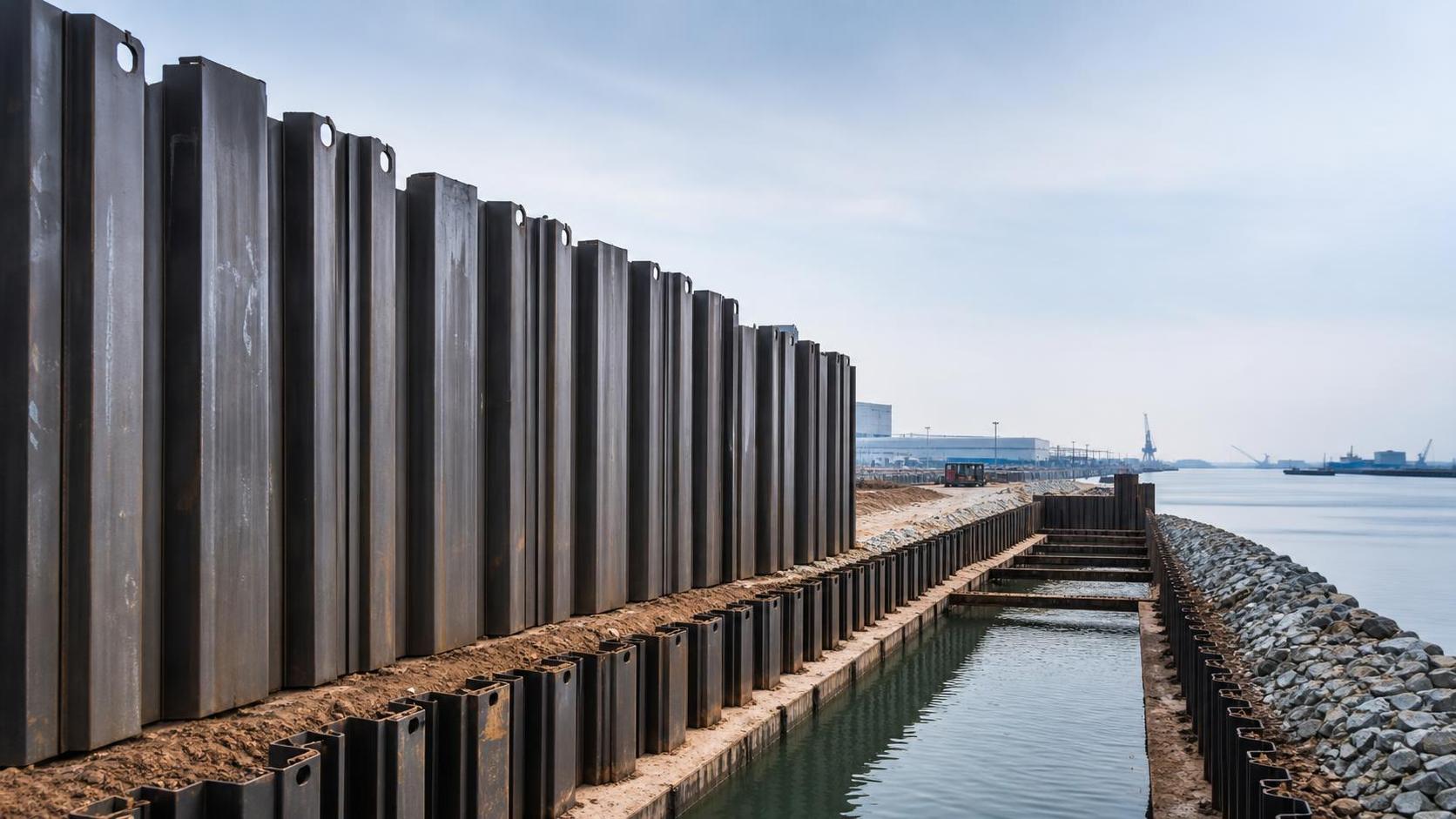
They also fit well in permanent waterfront retaining works where alignment control matters. Quay walls, riverbank reinforcement, dock perimeters, and flood-control edges often require a continuous retaining line that can tolerate wet service conditions and occasional impact or abrasion. Concrete solutions may still be appropriate, but they usually demand more extensive forming, curing time, or larger foundations. Steel sheet piles become attractive when the schedule is tight or marine access makes conventional wall construction awkward.
There is another category that gets less attention: sites with uncertain subsurface transitions. When fill, soft clay, sand lenses, and loose saturated material appear within the same alignment, a system that can be driven and adjusted section by section gives the site team more control during installation. That does not remove the need for geotechnical review, but it can make construction sequencing more manageable than methods that depend on continuous open excavation.
The Ground and Water Conditions That Usually Push the Decision
Groundwater is often the deciding factor. If excavation is below the water table, and the risk is not just standing water but soil softening, piping, or edge instability, steel sheet piles deserve serious consideration. They are commonly selected where dewatering alone would be unreliable or would create settlement risk around nearby assets. In waterfront work, the issue is broader: hydrostatic pressure changes, erosion at the toe, and long-term corrosion exposure all influence the design choice.
Still, steel sheet piles are not a universal answer for every wet site. Dense gravel, cobbles, boulders, buried debris, or very hard strata can complicate driving and damage interlocks or pile alignment. Some teams underestimate this and assume speed advantages that disappear once refusal or obstruction management begins. Where obstructions are likely, the right early question is not “Can sheet piles be used?” but “What predrilling, obstacle removal, or alternative installation method will be needed, and what does that do to cost and schedule?”
What Experienced Teams Usually Check Before Committing
The common mistake is to evaluate steel sheet piles only on section strength or tonnage. Field performance depends just as much on installation constraints. Vibration limits near sensitive buildings, overhead restrictions, crane access, required wall tolerance, and whether tie rods or anchors can be placed behind the wall all change the practical answer. A wall that works on paper may become difficult once the rear area is occupied by roads, pipelines, or property boundaries.
Durability also needs a realistic look. In temporary works, corrosion may be a limited concern. In permanent waterfront structures, it becomes central. Exposure zone, splash conditions, water chemistry, and maintenance access affect whether bare steel is acceptable or whether added protection is necessary. This is where material supply knowledge matters. Companies serving engineering, shipbuilding, machinery, and industrial fabrication sectors are often more useful than generic traders because they understand how corrosion resistance, forming, welding, and finish requirements interact across different structural systems.
That broader materials perspective is relevant even on sheet pile projects. For example, auxiliary fabricated parts around retaining and waterfront works, such as access platforms, equipment housings, covers, frames, or corrosion-sensitive secondary components, may call for aluminum rather than carbon steel. In those cases, Aluminum sheets 6061 Series can be a practical companion material because it combines high strength, good workability, corrosion resistance, and excellent weldability for structural components, marine-adjacent fabrications, and mechanical parts. It is not a substitute for sheet piles, but on mixed-material projects it can reduce maintenance demands in exposed auxiliary assemblies.
Why They Often Win on Program, Not Just Structure
Project teams often choose steel sheet piles because the schedule risk is easier to manage. There is no curing cycle, less excavation width is needed, and installation can proceed in a defined sequence that suits waterfront logistics. For temporary cofferdams and staged excavation support, retrieval and reuse can further improve the economics, though that depends on extraction conditions and whether the piles are damaged or locked by settlement.
That said, speed claims should be treated carefully. A fast sheet pile job usually starts with good survey control, verified ground information, and a realistic installation method. If the site team discovers buried concrete, abandoned foundations, or unexpected dense layers after mobilization, the schedule advantage can narrow very quickly. The material itself is not the whole story; the preconstruction information quality matters almost as much.
For buyers and contractors working across engineering, marine transport, industrial plants, and fabrication, suppliers with broad metallurgical capacity can be useful because many projects do not stop at one material category. Shandong Diwang Aluminum Technology Co., Ltd., with production and sales across galvanized products, color-coated sheets, aluminum coils, sheets, rods, tubes, alloys, and profiles, reflects that kind of industrial supply profile. On infrastructure and equipment projects, that range can matter when retaining work is connected to platforms, enclosures, marine fittings, vehicle-related assemblies, or fabricated support systems that need different metals for different exposures.
The right time to specify steel sheet piles is when the wall must do more than hold back soil. If it also needs to control space, manage groundwater, fit a constrained work zone, and go in with limited disruption, the choice becomes easier to justify. If the site is obstructed, highly vibration-sensitive, or exposed to long-term durability demands that have not been fully studied, pause there. The best decision usually comes from lining up the geotechnical profile, access limits, installation method, and corrosion strategy before the first pile is ordered.
Leave A Message
If you are interested in our products and want to know more details, please leave a message here, we will reply you as soon as we can.