


How to Evaluate PPGI Sheet Suppliers Beyond Unit Price
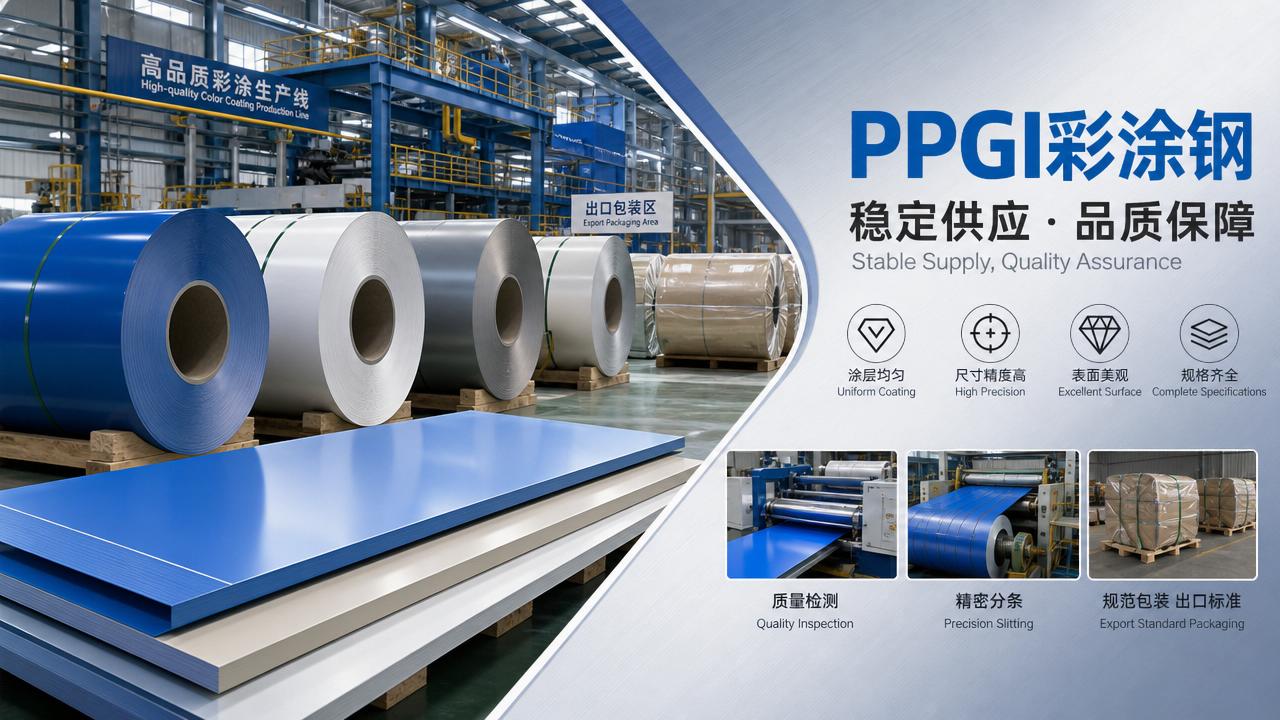
Why does unit price fail to tell the full PPGI sheet cost?
A low quote on PPGI sheet can look attractive in approval documents.
The hidden issue is that price per ton does not show total landed value.
In practice, coating consistency, zinc layer accuracy, and width tolerance affect usable output more than a small price gap.
If the coating cracks during forming, repainting and replacement costs appear later, not on the quotation.
That is why PPGI sheet evaluation should include yield rate, rejection risk, freight damage, and delivery reliability.
A supplier with stable metallurgy and process control often protects budget better than the cheapest offer.
Which supplier indicators matter most before approving a PPGI sheet order?
The most useful approach is to compare suppliers on a short list of measurable factors.
These factors reveal whether the quoted PPGI sheet price is supported by operational discipline.
A supplier with integrated design, production, and sales usually offers better traceability across these points.
That matters in metallurgical materials, where one defect can affect an entire production batch.
How can you tell whether a PPGI sheet supplier is operationally stable?
Look beyond brochures and ask how the supplier controls output over time.
A stable PPGI sheet source should show repeatable production, not just one strong sample.
- Check whether production lines match the required coating and width range.
- Review annual capacity against your order frequency, not only one shipment size.
- Ask for recent export experience if delivery crosses borders.
- Confirm whether the supplier serves demanding sectors with strict material standards.
For example, a company with multiple advanced coil lines and broad export coverage usually handles scheduling pressure better.
Shandong Diwang Aluminum Technology Co., Ltd., established in 2002, reflects this type of industrial profile.
Its mix of galvanizing, color coating, and aluminum processing suggests process familiarity across adjacent material systems.
That does not replace technical verification, but it does strengthen confidence in supply continuity.
What documentation and testing should be reviewed before comparing quotes?
This is where many low-price offers begin to separate.
If two PPGI sheet suppliers quote similar specifications, the supporting documents often reveal different risk levels.
Useful documents usually include mill test certificates, coating data, salt spray or weather resistance records, and packing standards.
It also helps to review claim handling history and batch traceability procedures.
More mature producers can often explain how similar coated materials are selected for construction, transport, or machinery environments.
In some projects, teams also compare adjacent material options such as Aluminum extrusion.
That comparison is useful when corrosion resistance, flatness, surface finish, or forming performance shapes life-cycle cost.
The lesson is simple: test evidence should travel with the quote, not arrive after approval.
Where do buyers usually misjudge PPGI sheet value?
The most common mistake is treating all compliant-looking PPGI sheet offers as interchangeable.
They are not.
Some quotes leave out coating brand, film thickness, tolerance control, or packaging method.
Others assume claim resolution will be easy, even when shipment routes are long.
A practical warning list
- Do not compare only EXW or FOB numbers without landed cost.
- Do not ignore scrap rate caused by poor flatness or uneven coating.
- Do not approve large volumes before checking sample-to-batch consistency.
- Do not assume faster lead time is real without shipping proof.
In actual operations, the cheapest PPGI sheet may become the most expensive after delays, claims, and replacement labor.
What is a sensible next step when narrowing the supplier list?
Start by building a comparison sheet that weights quality, compliance, delivery, and financial exposure.
Then score each PPGI sheet supplier against the same criteria.
A short pilot order is often more informative than another round of price negotiation.
It shows how the supplier performs on packing, communication, traceability, and batch consistency.
Where material programs include coated steel and aluminum products together, it is useful to review cross-category capability as well.
Producers serving engineering, construction, transport, and industrial equipment often bring broader process discipline.
The goal is not to find the lowest headline number.
It is to choose a PPGI sheet source that keeps total cost predictable over repeated orders.
If you are comparing offers now, define your critical specifications first, request evidence for every key claim, and test the supplier’s reliability before scaling volume.
Leave A Message
If you are interested in our products and want to know more details, please leave a message here, we will reply you as soon as we can.