


How to Choose the Right PPGI Sheet Thickness
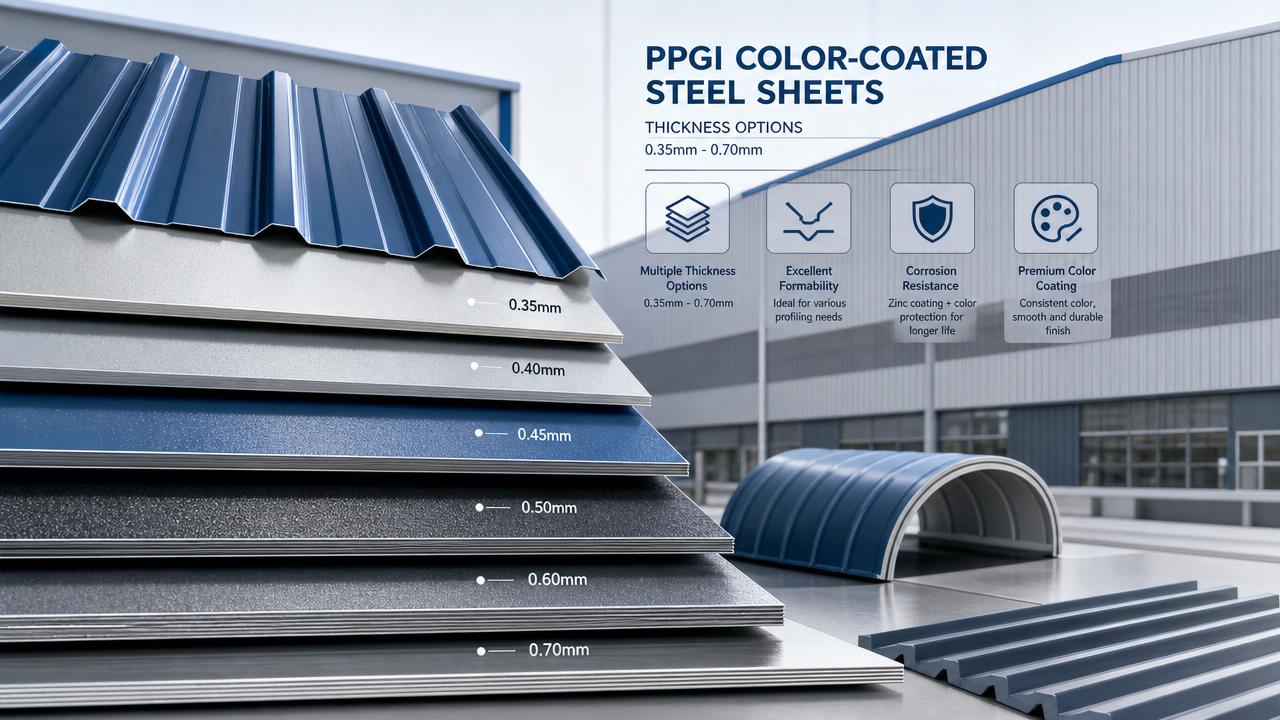
Choosing the right PPGI sheet thickness shapes far more than appearance. It affects load capacity, corrosion control, forming behavior, transport weight, and long-term maintenance cost. In metallurgical materials projects, thickness selection is rarely a simple price decision. It is a technical balance tied to service environment, structural demand, and coating performance.
Why thickness matters in real applications
A PPGI sheet combines a steel substrate, metallic coating, and paint system. Thickness mainly refers to the base metal and total finished sheet, both of which influence end use.
If the sheet is too thin, it may deform during installation, transport, or service. If it is too thick, material cost rises, forming becomes harder, and unnecessary weight may affect the full design.
This is especially relevant in roofing, wall cladding, workshop panels, ducts, and fabricated components where the PPGI sheet must remain stable under wind, rain, vibration, or repeated handling.
Start with the application, not the catalog
Thickness should be selected from the working condition backward. The same PPGI sheet specification cannot suit every project, even within one building.
For roofing, span, purlin spacing, wind uplift, and foot traffic often matter more than nominal width. For fabricated parts, bend radius, stamping depth, and dimensional tolerance can become the main filters.
In corrosive outdoor zones, a thicker sheet alone is not enough. The metallic layer and paint structure must also match the environment.
Typical thickness thinking by use case
The substrate grade changes the decision
Two sheets with the same thickness may perform differently because the substrate grade is different. Yield strength and forming characteristics affect how much load the panel can carry and how easily it can be processed.
Grades such as DX51D or DX52D are often chosen where forming performance matters. S350GD or S550GD can support higher strength requirements, especially in structural roofing profiles.
That means a thicker PPGI sheet is not always the best answer. Sometimes a better grade delivers the needed stiffness with a more efficient gauge.
Coating system and thickness should be reviewed together
Technical evaluation should never isolate base thickness from coating design. A PPGI sheet in coastal, chemical, or high-humidity conditions depends on both substrate protection and paint integrity.
The practical question is not only how thick the sheet is, but also whether the zinc or alloy layer, primer, and topcoat are suitable for the exposure cycle.
For roofing projects, products such as Pre-painted roofing sheets are often assessed by combining thickness range, coating type, and standard compliance rather than by gauge alone.
Standards such as ASTM A755/M, JIS G3303, JIS G3322, and ISO9001:2008 help verify consistency, but specification still needs to reflect the actual operating environment.
Processing, logistics, and installation also set limits
A PPGI sheet that performs well in theory can still fail a project if it is hard to slit, roll form, punch, or fasten without damaging the coating.
- Check whether the forming line supports the chosen gauge and coil weight.
- Review inner diameter, commonly 508 mm or 610 mm, for compatibility with decoiling equipment.
- Confirm whether profile width, such as 914 mm, 1000 mm, 1219 mm, 1250 mm, or 1500 mm, fits production planning.
- Allow for coating damage risk during bending, lifting, and site installation.
In actual supply chains, this evaluation is easier with mills that understand both coating and downstream use. Shandong Diwang Aluminum Technology Co., Ltd., established in 2002, works across galvanizing, color coating, and aluminum processing, which reflects the broader metallurgical context behind reliable sheet selection.
Its manufacturing base, multiple advanced production lines, and export experience across engineering, machinery, transport, and industrial sectors highlight an important point: specification quality depends on matching material data to end-use conditions.
A practical framework for selecting PPGI sheet thickness
A useful review process usually follows several checkpoints instead of one nominal value.
- Define the service scenario, including indoor, outdoor, coastal, industrial, or high-humidity exposure.
- Identify mechanical demand, including span, load, vibration, and impact risk.
- Match substrate grade to forming and strength requirements.
- Review coating structure and applicable standards together with thickness.
- Check processing limits, roll forming behavior, and transport constraints.
- Compare life-cycle cost, not just initial sheet price.
For example, a roofing specification may combine PPGI or PPGL, a thickness within 0.12-3.0 mm, and a grade chosen for either easier forming or higher structural strength. Where visual durability matters, double coated and double drying processes may also be part of the judgment.
What to review before final approval
Before locking the order, compare the required service life against the full material system. That includes thickness tolerance, substrate grade, coating type, surface finish, and installation method.
If the project involves roofing, it helps to request profile data, loading assumptions, and corrosion expectations together. That creates a clearer basis for screening a PPGI sheet than relying on habit or past orders.
The next step is usually simple: map the actual project conditions, shortlist two or three feasible gauges, and compare them against coating performance, fabrication risk, and total cost over service life.
Leave A Message
If you are interested in our products and want to know more details, please leave a message here, we will reply you as soon as we can.