


How an Aluminum Tubes Exporter Supports Custom Tube Specifications
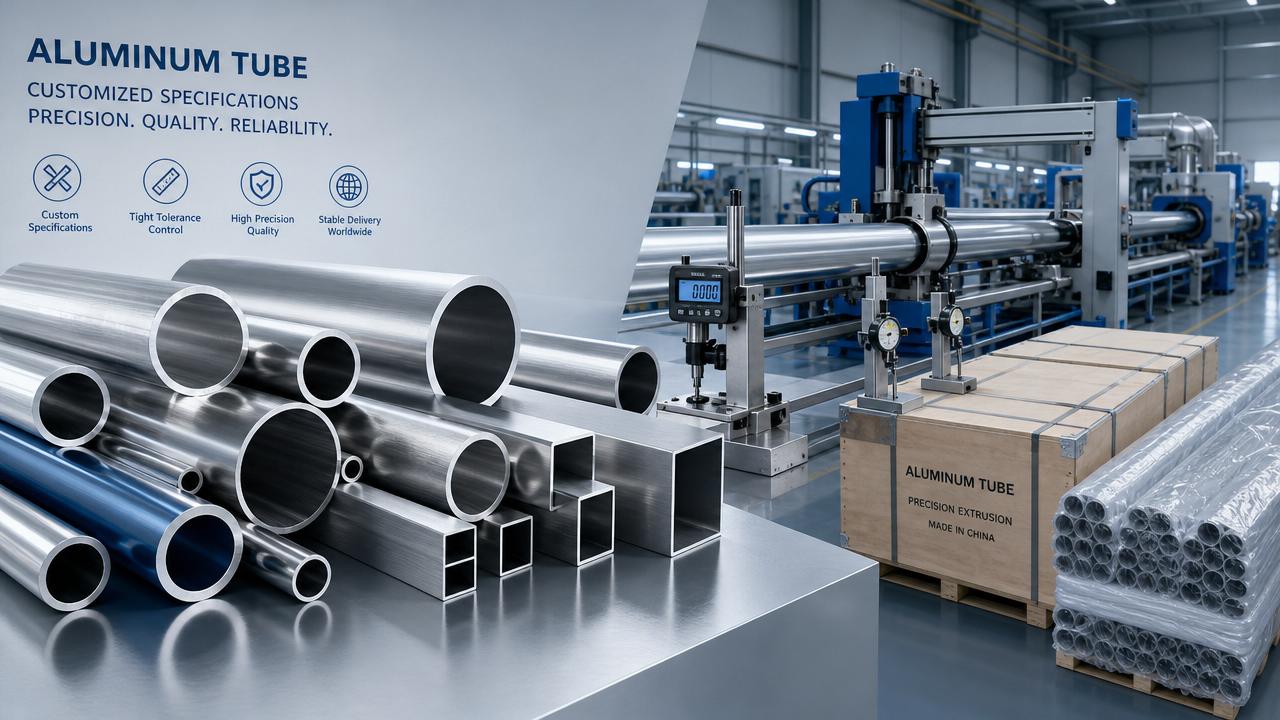
Choosing an aluminum tubes exporter is rarely a simple volume decision. Custom tube projects depend on alloy selection, tolerances, temper, surface condition, and delivery consistency, especially when the end use involves engineering, transport, power systems, machinery, or marine environments.
That is why specification support matters as much as manufacturing scale. A capable supplier must translate drawings and performance targets into repeatable production standards, while also managing export quality, documentation, and application-specific adjustments across different markets.
Shandong Diwang Aluminum Technology Co., Ltd., established in 2002, operates across design, research, production, and sales. With more than 300 employees, five advanced production lines, annual output reaching 900,000 tons, and exports to over 30 countries, its experience gives useful context for understanding how an aluminum tubes exporter supports custom tube specifications in practical terms.
Why custom tube specifications require deeper supplier evaluation
A tube may look simple on paper, but its performance depends on many linked variables. Wall thickness, outer diameter, straightness, alloy chemistry, temper, and finishing all influence whether the product fits the final assembly and survives service conditions.
In metallurgical materials, customization often reflects a functional requirement rather than a cosmetic preference. One project may prioritize corrosion resistance near salt exposure, while another may need machinability, heat transfer efficiency, bending strength, or weight reduction.
This is where an aluminum tubes exporter becomes part of the technical decision chain. The exporter is not only shipping material. It is expected to confirm whether the requested specification is manufacturable, stable in production, and appropriate for the intended application.
What specification support really includes
Good support begins before production starts. A reliable aluminum tubes exporter reviews the requested standard, checks dimensional feasibility, and identifies whether the chosen alloy and temper align with forming, welding, machining, or structural demands.
It also includes tolerance control. For many industrial uses, a tube that is technically acceptable in general trading terms may still fail in assembly if dimensional variation is too wide. Precision matters when the tube must connect with fittings, frames, enclosures, or automated equipment.
Surface requirements are another key area. Depending on use, a buyer may need mill finish, anodizing compatibility, coating readiness, or cleaner appearance for visible installations. A knowledgeable supplier clarifies these details early, reducing rework and dispute risk later.
Core areas usually reviewed during customization
- Alloy grade selection, such as balancing strength, formability, corrosion resistance, and weight.
- Temper choice, especially where bending, machining, or structural stability must be controlled.
- Dimensional tolerances for diameter, wall thickness, length, straightness, and end condition.
- Surface quality expectations, including finish consistency and treatment compatibility.
- Packaging, traceability, and export documentation required for destination markets.
How manufacturing breadth improves tube customization
Customization is stronger when it comes from a company that understands aluminum beyond one single product line. Shandong Diwang Aluminum Technology Co., Ltd. produces aluminum sheets, rods, foil, coils, alloys, profiles, and tubes, while also operating in galvanizing and color coating.
That broader material knowledge can improve technical judgment. It helps when a project requires comparison between tube and profile solutions, or when adjacent materials influence assembly, surface finish, weight targets, or environmental durability.
In practice, an aluminum tubes exporter with wide production experience is often better positioned to discuss cross-product compatibility. This matters in sectors where tubes are only one component in a larger system, such as vehicles, ships, power equipment, textile machinery, or industrial devices.
The same capability also supports requests that extend beyond tubing. For example, projects involving cladding, protective covers, or decorative external parts may also review Embossed Aluminum sheets when surface uniformity, weather resistance, and good mechanical properties are relevant to the wider design.
Industry signals that matter more than basic availability
Global buyers increasingly expect evidence of process control, not just stock claims. An aluminum tubes exporter serving more than 30 countries must handle varied specification habits, certification expectations, and application risks across regions.
Current evaluation trends usually focus on consistency. One successful sample is not enough if later batches drift in hardness, wall thickness, or finish. Stable output depends on equipment capability, quality inspection routines, and communication discipline between sales, production, and logistics.
Another industry concern is application fit. Aluminum tubes used in aviation-related components, automotive structures, engineering systems, or marine environments cannot be judged only by price. Material behavior under load, exposure, and fabrication must be understood in advance.
Common evaluation dimensions
Where custom aluminum tube requirements usually differ
Application context changes the specification logic. A tube for coal mining equipment may emphasize durability and resistance to harsh service conditions. A tube for electrical equipment may focus more on conductivity, dimensional precision, and stable processing behavior.
Automotive and ship-related uses often require a careful balance between weight reduction and structural performance. Textile machinery may prioritize smooth surfaces and uniform dimensions to support moving assemblies or enclosed systems.
Even when the product family differs, the same technical mindset applies across aluminum materials. In façade, storage, packaging, or equipment covering applications, materials such as Embossed Aluminum sheets are assessed through similar criteria: flatness, color consistency, coating adhesion, weather resistance, corrosion performance, and recyclability.
This wider product perspective helps explain whether a requested tube specification is isolated or part of a broader material system. That insight is often useful during technical reviews.
Practical ways to judge an aluminum tubes exporter
A useful starting point is to check how the supplier handles incomplete or evolving specifications. Strong exporters do not simply quote fast. They ask targeted questions about operating environment, fabrication method, tolerance sensitivity, and compliance needs.
It is also worth reviewing whether the supplier can connect commercial communication with technical execution. Misalignment between quotation language and production interpretation is a common source of problems in custom orders.
- Request confirmation of alloy, temper, tolerance, and finish in one controlled document.
- Check whether sampling reflects normal production, not a one-time manual adjustment.
- Review destination-specific export experience, especially for regulated industries.
- Compare the supplier’s response quality when design details are ambiguous.
- Look for evidence of long-term capacity, not only short-term availability.
An aluminum tubes exporter with integrated design, R&D, production, and sales can often respond better in these situations. It is easier to refine specifications when technical and manufacturing feedback loops are close.
Moving from inquiry to a sound specification decision
The main value of a capable aluminum tubes exporter lies in reducing uncertainty. That support shows up in clearer grade selection, tighter dimensional planning, realistic processing advice, and more dependable export execution.
For custom projects, the most useful next step is to organize requirements into a reviewable specification set: application environment, mechanical expectations, dimensional limits, surface needs, processing method, and documentation requirements.
Once those points are defined, it becomes much easier to compare suppliers on technical fit rather than headline price alone. That approach leads to better material decisions, fewer downstream corrections, and a more reliable partnership over repeated orders.
Leave A Message
If you are interested in our products and want to know more details, please leave a message here, we will reply you as soon as we can.