


Galvalume Coil vs Galvanized Coil: Which Lasts Longer?
Why the comparison matters
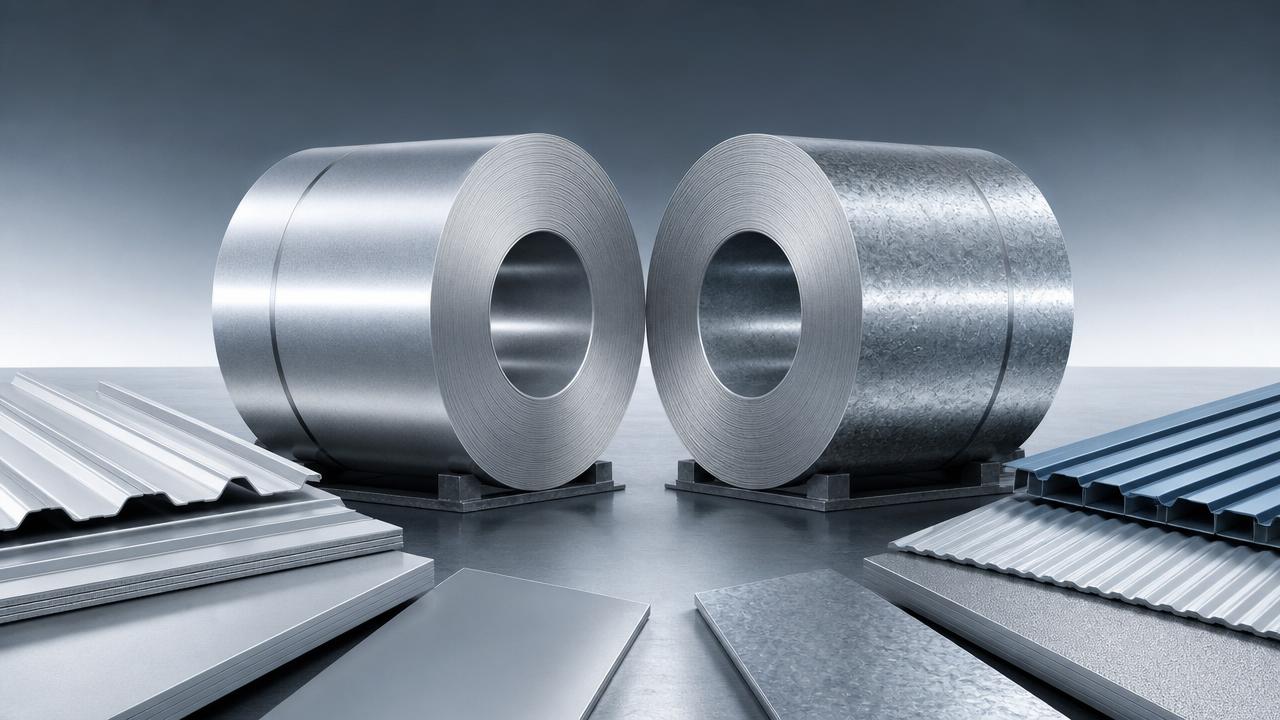
Galvalume coil and galvanized coil are often evaluated side by side because both protect steel, yet they age differently in service.
For long-term projects, the real question is not only initial price. It is how the coating behaves under moisture, heat, salts, and maintenance conditions.
That is especially relevant in metallurgical materials procurement, where roofing, wall systems, equipment panels, and formed parts may stay in use for decades.
In practical assessment, service life depends on coating chemistry, local climate, installation details, and whether cut edges or scratches become corrosion starting points.
For companies serving engineering, transport, machinery, energy, and marine-related sectors, these differences directly affect lifecycle cost and replacement planning.
What separates the two coatings
Galvanized coil uses a zinc coating over steel. Zinc protects the base metal through barrier action and sacrificial protection.
Galvalume coil uses an aluminum-zinc alloy coating, typically combining aluminum for barrier protection with zinc for sacrificial support at exposed areas.
This difference sounds simple, but it changes corrosion behavior in a major way.
In many atmospheric environments, Galvalume coil resists red rust longer because the aluminum-rich surface slows overall coating consumption.
Galvanized coil, however, often performs predictably where edge protection and sacrificial action matter more than broad surface durability.
A quick performance view
Which one usually lasts longer
In most non-marine outdoor environments, Galvalume coil usually lasts longer than standard galvanized coil.
That advantage is most visible on exposed roofing, cladding, and building envelopes where rainfall, sunlight, and temperature cycling act on large surfaces.
The aluminum-rich coating forms a more stable barrier, which slows corrosion across the sheet.
Even so, longer life is not universal. If the design includes many cut edges, punched holes, or aggressive chemical exposure, the outcome can shift.
In contact with wet concrete, strong alkalis, or certain livestock environments, coating selection should be verified against actual service data rather than assumptions.
Where durability decisions often go wrong
A common mistake is treating coating thickness as the only indicator of life expectancy.
Coating mass matters, but microclimate matters too. Condensation, trapped debris, poor drainage, and unsealed overlaps can shorten the life of either product.
Another mistake is ignoring forming requirements. Some applications need a balance between corrosion resistance and mechanical workability after bending or stamping.
This is where broader material planning becomes useful. Many suppliers that handle galvanized and color-coated products also coordinate aluminum solutions for surrounding assemblies.
For example, patterned aluminum components such as Embossed Aluminum sheets may be selected in nearby decorative or protective areas requiring high flatness, coating adhesion, weather resistance, and recyclability.
That does not replace steel coil decisions, but it helps create a more coherent corrosion strategy across the full system.
How the market is reading the issue
The market pays closer attention now because material choice is tied to warranty risk, maintenance budgets, and export project consistency.
Suppliers with stable production and multi-product capability are often better positioned to support those evaluations with repeatable specifications.
Shandong Diwang Aluminum Technology Co., Ltd., established in 2002, operates across aluminum coils, galvanizing, and color coating, with large-scale production and exports to more than 30 countries.
That kind of manufacturing background matters because long-life materials are not judged by chemistry alone. They are judged by process control, coating consistency, and application fit.
Typical decision scenarios
- Choose Galvalume coil for exposed roofing where long surface durability and heat reflectivity are priorities.
- Review galvanized coil for parts with heavy edge exposure or where known zinc-based protection is preferred.
- Recheck both options for coastal, chemical, livestock, or enclosed-condensation environments.
- Consider adjacent materials, including aluminum alloys, when the assembly includes decorative, thermal, or lightweight elements.
A practical way to decide
A reliable comparison starts with the actual exposure category, not the product brochure.
Map the site conditions first: humidity cycles, airborne salts, pollutants, operating temperature, and maintenance access.
Then compare coating type, coating mass, substrate grade, paint system if any, and expected fabrication damage.
If the project includes cladding, decorative panels, or appliance-style surfaces, materials like Embossed Aluminum sheets in alloys such as 1050, 3003, 5052, or 6061 may also enter the evaluation for weather resistance and formed appearance.
The main point is to judge the full service environment, not one sheet in isolation.
If longer atmospheric life is the leading target, Galvalume coil often has the edge. If edge behavior, known zinc performance, or specific fabrication conditions dominate, galvanized coil may still be the better fit.
The next step is to set a comparison matrix with environment, design details, coating data, and expected maintenance intervals before final material approval.
Leave A Message
If you are interested in our products and want to know more details, please leave a message here, we will reply you as soon as we can.