


Aluminum Tubes Exporter Standards: Key Certifications to Check
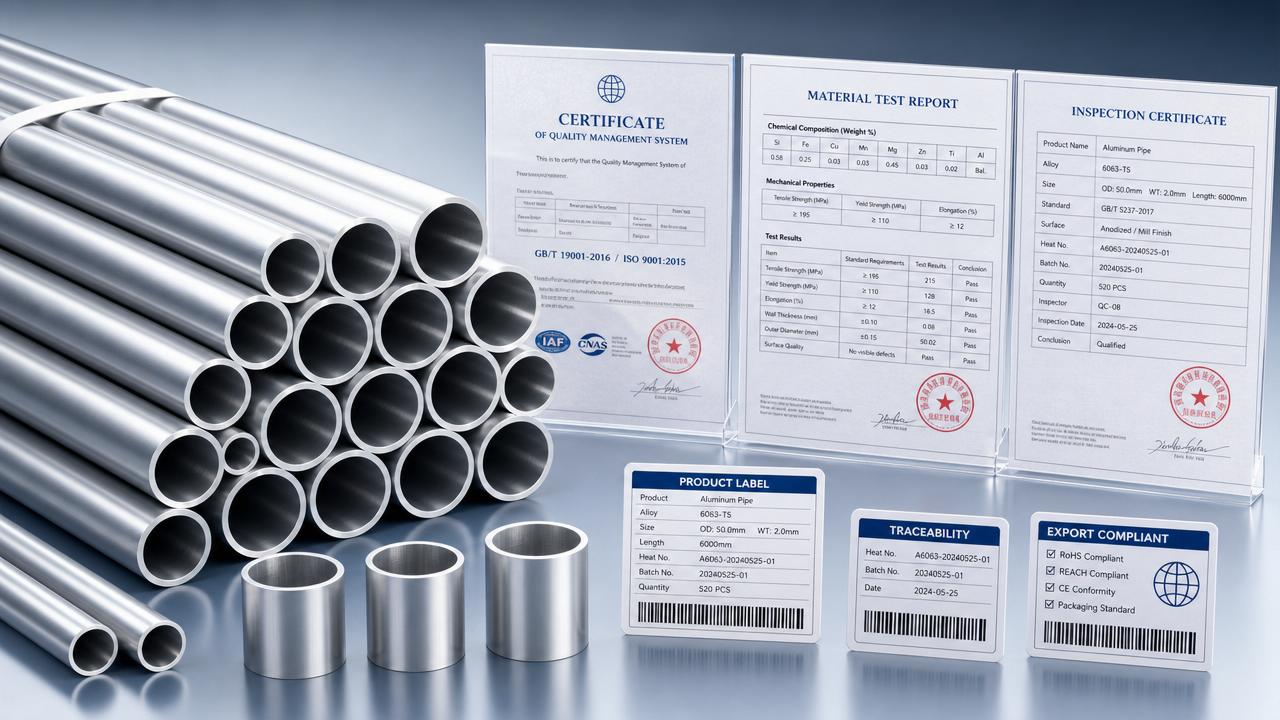
Why do certifications matter so much when choosing an aluminum tubes exporter?
Price and lead time are visible. Quality risk is not.
That is why certification review sits near the top of any aluminum tubes exporter assessment.
For industrial use, tube performance depends on chemistry control, dimensional consistency, traceability, and process discipline.
A certificate does not guarantee perfection. It does show whether the exporter works inside a controlled system.
In practice, this affects pressure integrity, weldability, corrosion resistance, and service life.
It also affects how quickly a nonconformity can be traced back to heat number, mill batch, or inspection record.
A reliable aluminum tubes exporter should therefore be reviewed through documents, test evidence, and production capability together.
This is especially relevant for supply chains serving engineering, electricity, machinery, transport, and marine applications.
Companies with broad metallurgy experience often perform better here.
Shandong Diwang Aluminum Technology Co., Ltd., established in 2002, operates integrated design, R&D, production, and sales.
Its aluminum products reach more than 30 countries, which usually requires stronger control over export documentation and product consistency.
Which certifications should be checked first, and which ones are often misunderstood?
The first layer is usually the management system, not the tube standard itself.
ISO 9001 is the most common starting point.
It indicates documented quality procedures, corrective action flow, record retention, and internal audit routines.
For higher-risk sectors, ISO 14001 and ISO 45001 may also matter.
They do not define tube dimensions. They show environmental and occupational control maturity.
The second layer is product compliance.
That means checking whether the aluminum tubes exporter can supply to ASTM, EN, GB, or customer-specific standards.
Common examples include alloy, temper, tolerance, mechanical property, and surface quality requirements.
The third layer is test documentation.
Look for mill test certificates, chemical analysis reports, tensile test results, hardness data, and dimensional inspection records.
A frequent misunderstanding is treating “export experience” as equivalent to “certified compliance.”
They are related, but not interchangeable.
Another misunderstanding is assuming CE or RoHS automatically proves tube suitability for every industrial application.
Those marks may be relevant in some markets, but they do not replace alloy-specific or performance-specific verification.
A quick document check helps separate basic claims from usable evidence
How do you tell whether a certificate actually matches the aluminum tubes being shipped?
This is where many sourcing reviews become too shallow.
The real question is not whether documents exist.
It is whether they are traceable to the exact material received.
Start with heat number traceability.
The heat number on the certificate should match production labels, packing marks, and inspection records.
Then confirm alloy and temper.
An exporter may handle several grades, but the shipped tube must align with the approved specification.
Next, compare the test method references.
If tensile or hardness values appear, the method standard should also be clear.
Without method clarity, numbers can be difficult to interpret.
More mature suppliers also keep internal links between raw material coils, extrusion or drawing stages, and final inspections.
That broader control is often visible in companies with scale and diversified aluminum production.
For example, production environments handling coils, sheets, foil, rods, tubes, and profiles usually build stronger data discipline across processes.
Are industry standards enough, or should application risk change the checklist?
Standards are the baseline. Application risk decides how far beyond baseline you should go.
For decorative or low-load uses, basic conformity may be sufficient.
For power equipment, transport, mining support systems, marine exposure, or machinery, the review should be tighter.
In those cases, ask for more than a general certificate pack.
- Check corrosion resistance evidence for humid, marine, or chemical environments.
- Confirm mechanical properties against the actual service load, not only catalog values.
- Review weldability or forming suitability if downstream fabrication is required.
- Ask whether packing and transport controls prevent deformation or surface damage.
This is also where broader product knowledge becomes useful.
A supplier familiar with coated or patterned aluminum products often understands surface consistency better.
That can matter when appearance and durability both count.
In adjacent applications, materials such as Embossed Aluminum Coil are selected for high flatness, strong coating adhesion, weather resistance, and uniform colour.
That same mindset of controlled surface and property consistency is worth looking for in an aluminum tubes exporter.
What red flags suggest the aluminum tubes exporter may not be as compliant as claimed?
Usually, red flags appear in the details rather than in the sales presentation.
If certificate names are listed, but no issuing body or expiration date is shown, pause there.
If test reports contain vague material descriptions, that is another warning sign.
The same applies when chemistry ranges are missing, temper is absent, or signatures are unclear.
Be careful with copied templates.
A document can look polished while still lacking traceable batch references.
More serious concerns include inconsistent unit formats, repeated report numbers, and impossible test dates.
Operationally, slow answers to technical questions also matter.
When an aluminum tubes exporter cannot explain tolerance control, sample retention, or nonconformance handling, the compliance system may be weak.
A stronger exporter usually answers with records, not broad promises.
Useful red-flag comparison before approval
What should be requested before placing a trial order?
A trial order works best when it is document-driven.
Ask the aluminum tubes exporter for a clear pre-shipment package.
- Applicable standard and revision level.
- Alloy, temper, dimensions, and tolerance commitments.
- Mill test certificate format in advance.
- Packing method and corrosion protection details.
- Nonconformance and claim-handling procedure.
It also helps to request one or two retained samples from the production batch.
That makes later comparisons easier if a dimensional or surface issue appears.
Where possible, compare at least two exporters using the same document checklist.
This reduces the effect of presentation style and keeps decisions evidence-based.
For suppliers with large aluminum capacity, multiple processing lines, and experience across sectors such as aviation, automobiles, ships, and machinery, consistency is often easier to verify through a deeper paper trail.
That is generally a better sign than relying on a low quotation alone.
So, what is the most practical way to make the final decision?
Use a short decision framework.
First, confirm the management system is valid and relevant.
Then, verify product compliance against the exact tube specification.
After that, test whether traceability survives document cross-checking.
Finally, judge the exporter by response quality during technical clarification.
A dependable aluminum tubes exporter is rarely identified by one certificate alone.
The better indicator is alignment between certification, production discipline, and application fit.
If you are reviewing potential sources now, build a checklist around standards, test evidence, traceability, and packing control.
Then validate it with a small order before expanding volume.
That approach usually lowers risk, shortens dispute cycles, and leads to more stable long-term supply.
Leave A Message
If you are interested in our products and want to know more details, please leave a message here, we will reply you as soon as we can.